
© 2026 Copyright | Gabriele Romeo | All Right Reserved

Gabriele Romeo, born in Palermo in 1983, is an art critic, curator, and academic whose professional career has made a significant contribution to the field of contemporary visual arts. A member of AICA International (International Association of Art Critics), he was elected President of the Italian National Section of AICA Italia (Associazione Internazionale dei Critici d’Arte) in April 2021 (re-elected for the 2026–2028 term) and currently serves as a Board Member of AICA International (Paris).
Since November 2024, he has been a tenured faculty member holding the chair of Phenomenology of Contemporary Arts at the Accademia Albertina di Belle Arti in Turin, where he is part of the School of New Technologies for Artand affiliated with the School of Communication and Enhancement of Contemporary Artistic Heritage.
His educational path began at an early age with a Diploma as Master Mosaic Artist from the Istituto Statale d’Arte per il Mosaico di Monreale (2000), followed by a Diploma of Applied Arts (2002). He graduated with highest honours in Sciences and Technologies of Art from the University of Palermo (2006) and obtained a Master’s Degree in Art History (Contemporary Art curriculum) from the University of Bologna (2009). In 2014, he completed the advanced training programme for curators ICON at the Fondazione Fotografia di Modena.
Between 2013 and 2016, he curated numerous exhibitions dedicated to emerging contemporary art in Venice, in collaboration with the Venice Carnival and the Fondazione Bevilacqua La Masa. He has curated exhibitions in prestigious venues and collaborated with leading artists and institutions. In 2017, he was appointed Curator of the Pavilion of the Plurinational State of Bolivia (Esencia) at the 57th International Art Exhibition – La Biennale di Venezia, under the curatorial direction of Christine Macel. The Bolivian National Pavilion was coordinated in collaboration with the National Museum of Art in La Paz, with José Bedoya Sáenz serving as Commissioner.
Alongside his curatorial activity, Romeo is the author of influential publications within the field of contemporary art. In 2018, he published the bilingual (Italian–English) essay #HASHTAGART: From Style to Neutralisation – Notes for a Phenomenology Applied to the Visual Arts (Skira), with a preface by Mark Gisbourne, in which he investigates the evolution of visual art and artistic styles through the language and dynamics of the so-called “Netflix Generation” (those born after 2013). In 2021, he published The Suspended Interval: The Chronic Connectome of Art (L’intervallo sospeso: connettoma cronico dell’arte, Mimesis), with a preface by Renato Barilli, addressing the relationship between art, time, and perception through a theoretical reflection on contemporary artistic practices, including an original analysis of a site-specific installation by the French street artist Dr. Ethan Raggac, an alias of the multidisciplinary intellectual Gaëten Grach.
In 2022, he was appointed by the Italian Ministry of Universities and Research as First-Level Professor of Phenomenology of Contemporary Arts at the Academy of Fine Arts of Reggio Calabria, where he taught until 2024courses including Phenomenology of Styles, Expressive Issues in Contemporary Art, Languages of Contemporary Art, and History and Methodology of Art Criticism. At the Accademia Albertina, he also teaches Children’s Literature and Illustration, delivering a monographic course devoted to Pre-Raphaelite art and the Arts and Crafts movement, with in-depth studies of authors such as Walter Crane, Aubrey Beardsley, Randolph Caldecott, Kate Greenaway, Arthur Rackham, Beatrix Potter, and John Tenniel.
In 2023, he curated the international conference Fluidity: International Meeting of Studies on the State of Art Criticism: Dynamic Updates (Turin, 5–6 May 2023), promoted by AICA Italia, with the participation of internationally renowned critics including Carolyn Christov-Bakargiev, Renato Barilli, Gian Maria Tosatti, Henry Meyric Hughes, Andrea Balzola, Pier Luigi Capucci, and the Historical Archives of La Biennale di Venezia.
In 2024, Romeo delivered the Laudatio for Marina Abramović on the occasion of her receiving the Diploma Honoris Causa in Performative Techniques for the Visual Arts at the Accademia Albertina di Belle Arti in Turin. In 2025, at the same institution and together with Sara Liuzzi, he delivered the Laudatio for Joseph Kosuth on the occasion of his receiving the Diploma ad Honorem in Phenomenology of Contemporary Arts.
He conceived and curated the cycle of video meetings Critical Talks, developed in collaboration with the Board of AICA Italia, launched in March 2025.
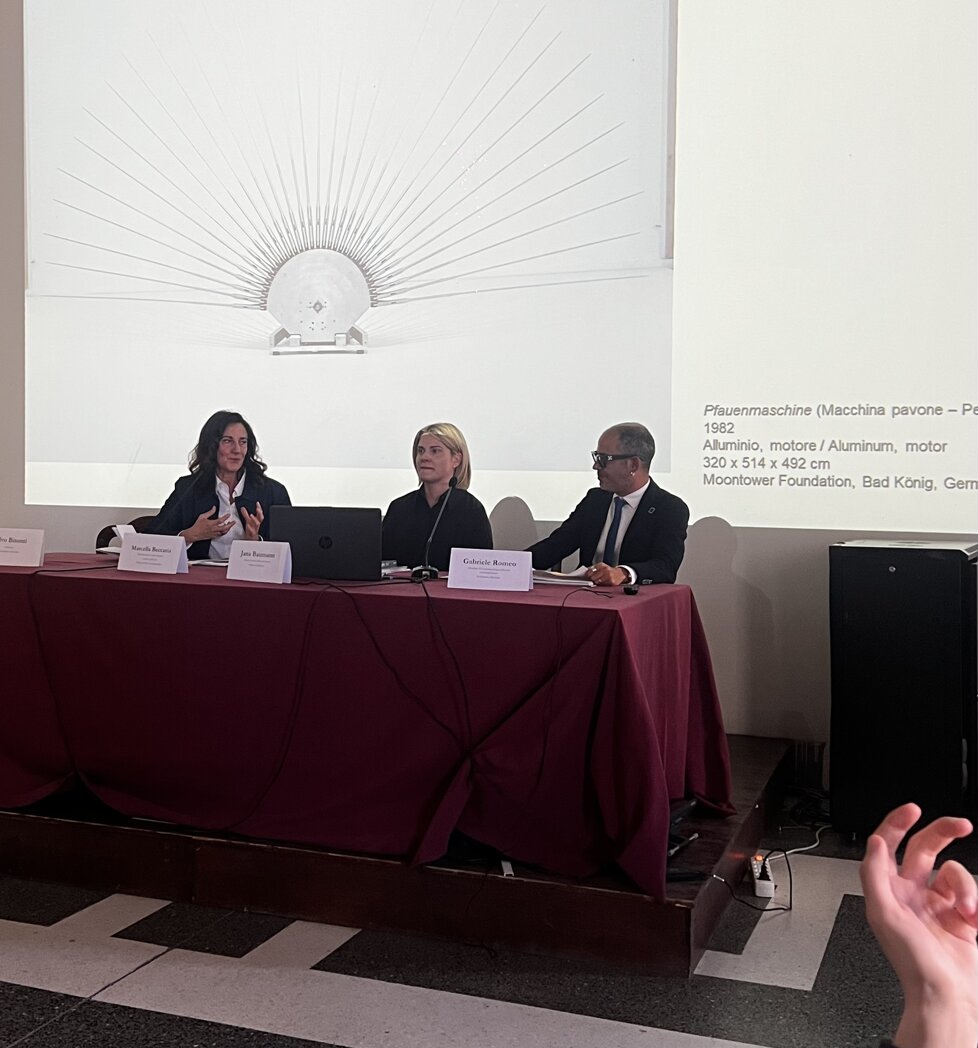
In 2025, Romeo was also invited to moderate the conference Rebecca Horn. Performativity of Bodies and Souls, held in Turin in conjunction with the exhibition “Rebecca Horn – Cutting Through the Past” at the Castello di Rivoli Museum of Contemporary Art, with contributions by Jana Baumann, Senior Curator at Haus der Kunst, Munich, and Marcella Beccaria, Deputy Director and Chief Curator of Castello di Rivoli.
On 30 July 2021, he participated as a speaker in the event FLOW TIME, within the concept Resilient Communities, at the Peccioli Laboratory in the Italian Pavilion of the 17th International Architecture Exhibition – La Biennale di Venezia, curated by Alessandro Melis, alongside Diego Repetto, Lanfranco Aceti, Fabian Mohedano, Fabrizio Aimar, Marco Brianza, and Fabrizio Rossetti. He was also invited as a speaker by the Joint Research Centre of the European Commission to the symposium Humanities and Artificial Intelligence, curated by Freddy Paul Grunert, where he presented the concept of PHENOMETER, a conceptual mapping tool designed to measure the impact of artworks on contemporary modes of reception, particularly among the Netflix Generation.
He has curated numerous editorial projects, including the volume From Kandinsky to Botero – All on a Single Thread(Da Kandinsky a Botero – Tutti in un filo, Skira, 2018), dedicated to twentieth-century art, featuring his critical essay “Arazzeria Scassa and the Art of the 20th Century”, published in conjunction with the exhibition held at Palazzo Zaguri, Venice.
Gabriele Romeo is also a visiting lecturer and invited speaker at numerous international universities and academies, participating in ERASMUS+ programmes. He has conducted workshops at institutions such as the University of the Arts Helsinki (2018), TAI Escuela Universitaria de Artes y Espectáculos, Madrid (2019), the Athens School of Fine Arts (2020–2021), the University of Montenegro, Podgorica (2022), and the University of West Attica, Athens(2023).
As an art critic, he has published articles and reviews in leading specialist journals, including JULIET, addressing the work of artists such as Ai Weiwei, Jeff Koons, Marina Abramović, Anselm Kiefer, Dario Fo, Giulio Paolini, David LaChapelle, Daniel Lismore, Joan Fontcuberta, Eugenio Carmi, Giorgio Celiberti, Carlo Guarienti, Pietro Carriglio, Hermann Nitsch, JR, EVA & ADELE, Maquiamelo, Silvère Jarrosson, Baseera Khan, Reza Aramesh, and Roger Ballen, among many others.
On 9 November 2025, within the programme “Patrimony / Heritage”, promoted under the patronage of the Australian Embassy in Italy, he presented the case study Hemorrhages of Pain at the MASA (Migration As Art Museum), at the invitation of curators Stephen and Meredith Copland, during their exhibition in Conzano.
He is Coordinator of the Historical Photographic Archive of the Accademia Albertina di Belle Arti and was a candidate for the International Vice-Presidency of AICA International in December 2025.
In recognition of his artistic and cultural merits, in 2025 he was appointed Chevalier de l’Ordre des Arts et des Lettresby the Ministry of Culture of the French Republic.